Duncan Berry displays new work at RiverSea Gallery
Published 3:46 pm Thursday, February 26, 2026






Gyotaku artist creates cross-cultural collaboration
Grief and beauty coalesce in artist Duncan Berry’s recent work on display at the RiverSea Gallery.
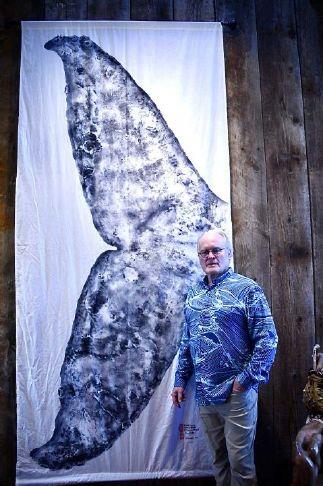
“I have been printing whales a lot lately, unfortunately,” he said. “In the show at RiverSea there will be the full size tail flukes and the high pectoral fin of a young humpback whale that washed up near Neskowin late last year. I printed it to raise awareness of why it died of malnutrition — radical changes in the climate and ocean conditions.”
The exhibit “Oceans in Common” will be on view during the FisherPoets Gathering which started on Friday and lasts through the weekend at the RiverSea Gallery at 1160 Commercial St. in Astoria. The show will be on view until March 10. Hours 11 a.m. to 5:30 p.m. Monday through Saturday and 11 a.m. to 4 p.m. on Sunday. The FisherPoets Gathering — in its 29th year — is a celebration of the commercial fishing industry through poetry, prose and song and will fill the downtown Astoria area with performances, workshops and related events. Find out more in the pull out FisherPoets schedule in this week’s edition of Coast Weekend or on the website: fisherpoets.org.
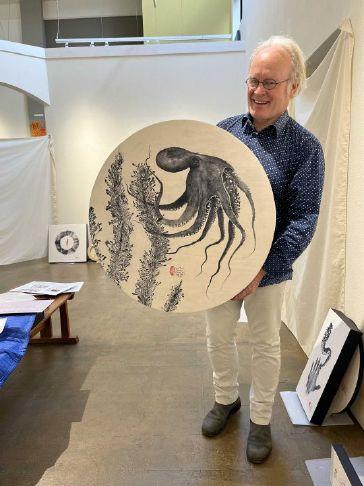
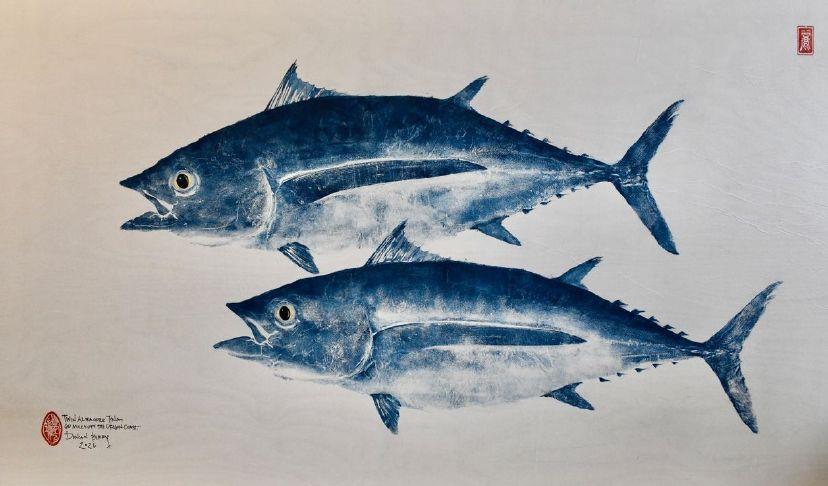
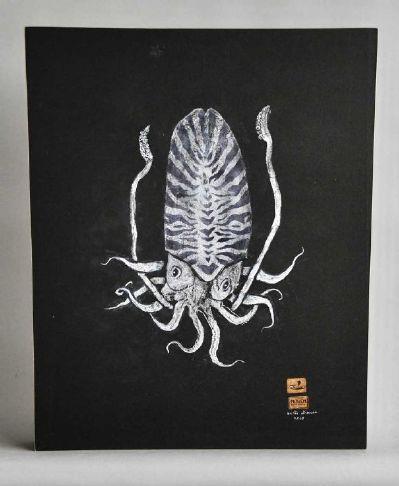
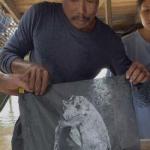
Berry, whose home is at Cascade Head, on the Oregon Coast between Lincoln City and Neskowin, is known for gyotaku — a traditional form of Japanese art that dates back to the 1800s. In Japanese, “gyo” means fish, while “taku” is the word for rubbing or impression. It was — and still is — a way for fishermen to keep a record of their catch by inking freshly caught fish and rubbing them with rice paper to create an exact image of a specimen.
In a show from 2023 at the RiverSea Gallery called “All My Relations,” Berry collected over 200 specimens of coastal creatures that came from the land, sea and air within one mile of his home. “The creatures in my artworks could be around for millennia, long after their bodily form would have passed from this earth. They are immortalized in the print. It’s a process of printing in which I use the same creatures over and over again. It’s an active form of reverence,” said Berry.
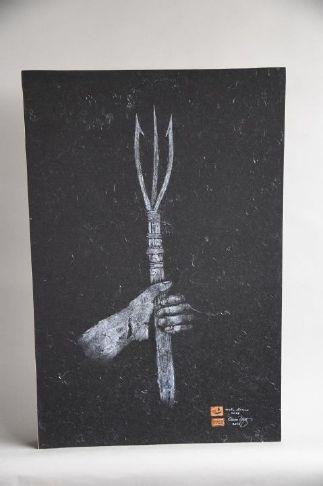
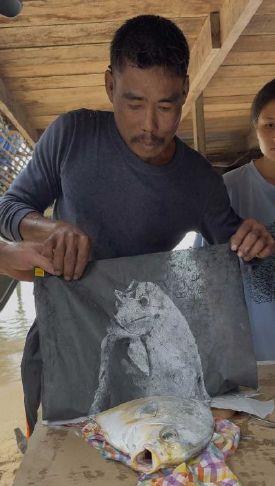
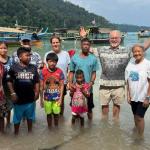
That reverence extends to all relations including marine and land creatures, but also to his connection with all seafaring people throughout the world. Berry — who is a former commercial fisherman — visited the Moken people, an Indigenous culture. The people there live in a village-on-stilts along the shore of the Andaman Sea near the Myanmar border. He taught gyotaku printing. He co-printed fish caught by traditional hand made catch methods local to their tropical waters through a collaboration with Ngui Klathale, Tribal leader of the Surin Moken Tribe.
This was not Berry’s first time to visit the islands. His wife, Melany Berry, was a co-leader in setting up the studio and working with the Moken people. “For the past two years we have been returning to the wilds of the Surin Islands 60 kilometers off of the coast of Thailand to work with the Indigenous and beautiful Moken people and a local nonprofit group Andaman Discoveries,” said Berry. Andaman Discoveries was started in response to the December 2004 tsunami.
The couple set up a place based art studio resulting in what Berry called “a remarkable cross-cultural collaboration across the Pacific. … My wife and I printed with members of the tribal village there for eight days, one of whom, Ngui Klathale, is the leader of the village and was able to pick up the technique very fast. So the RiverSea show contains works where we ‘buddy printed’ some really compelling images together, as well as some of his solo work printing alone,” said Berry.
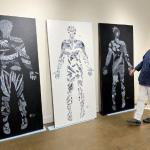
The purpose, he said, was to help sea-faring people express their lives artistically and make a living based on their culture and the beautiful place they live. The collection of artwork from that experience will be exhibited alongside Berry’s works at the gallery on mulberry paper and mounted birch panels. Proceeds will go to the Moken artist and a special fund to benefit the village.
Lands and waters of Oregon
Berry is also a poet and son of the late Oregon novelist Don Berry who is best known for a trilogy of historical novels: “Trask” (1960), “Moontrip” (1962), and “To Build a Ship” (1963) — for which he was a National Book Award nominee. Like his father, Berry, who makes impressions from wild creatures in nature, has deep ties to the wild natural places in Oregon, like the Columbia River. He says it is one of the greatest salmon rivers of all time.
In addition, Berry is the co-director and board president of the Cascade Head Biosphere Collaboration in Lincoln City. Through his work, he educates children by getting them outside into the wild and getting them thinking about the story of the salmon — the water cycles — as well as where we are now and where we could be headed in the future.
That personal ideology of creatures that inhabit our earth as relations, flows back into Berry’s art. “Rather than saying what a cool fish that is, I have been thinking, what is my relationship to that fish? The idea that there are humans and then there is nature is really an illusion. We are both in the same habitat where we naturally belong. There is no separation. The fish lives in the same waters that I drink from,” said Berry. “Let’s treat the creatures around us with the most gratitude and respect that they deserve. It’s revelatory to shift your thinking about them and their lives.”
Berry poses the question: “We are left with only 6% of our salmon. Could you imagine if the European colonizers had treated the salmon like our relations, what the outcome would have been?”
Find Berry at FisherPoets
At FisherPoets gatherings over the decades, Berry has been a fixture as an emcee, performer and teacher of workshops. This year he will teach a gyotaku workshop from noon to 3:30 p.m. on Friday, Feb. 27 at the Columbia River Maritime Museum’s Barbey Maritime Center, 2042 Marine Drive in Astoria. The workshop is a benefit with proceeds going to next year’s FisherPoets Gathering for poets who need assistance with travel expenses. The workshop will present a slower, more advanced technique making visual stories with elements from natural habitats like seaweeds, shellfish and sea rocks. No previous art experience is necessary. The cost is $125. To find out more visit: fisherpoets.org.
Berry will teach a second workshop from 9 a.m. to noon, Saturday, Feb. 28 at the same location called “Creatures of the Deep: Gyotaku Printing with Duncan Berry.” The workshop will explore the underwater world of Oregon’s coastline creating archival prints with salmon, lingcod, albacore, rockfish, skates, shrimp and squid. No previous art experience is necessary. Editor’s note: at time of publication, the workshop had a waiting list. To find out more or to join the waitlist visit: crmm.org/workshops.
Berry has scheduled performances throughout the weekend. He will perform sea shanties and poems at 9 p.m. Friday, Feb. 27 at the Kala Performance Space at 1017 Marine Drive, and at 6 p.m. on Saturday Feb. 28 at the Columbian Theatre, 1102 Marine Drive. A pop up of the artists oceanic apparel and art panels will be on hand at the FisherPoets Gathering’s “Gear Shack” at 1180 Marine Drive, a temporary space set up for the duration of the weekend, merchandising the wares of Berry and other fisher poets, including apparel, books, music and hand-made items — it will also serve as a central hub to answer questions about the event. People can also find Berry’s merch on his website: bylandbyseabyair.com.
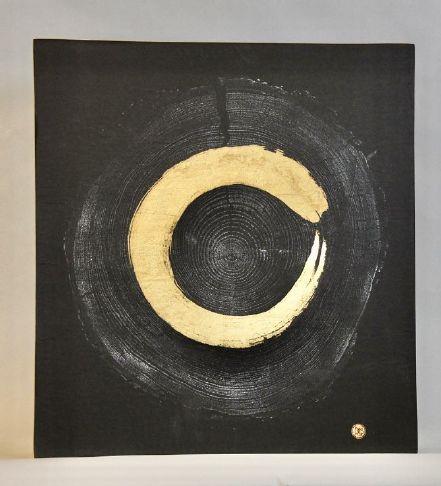
FisherPoets 2026 is upon us but Berry is already thinking about future work, ideas that are illuminated by a shimmer of gold. “I have been fascinated with 24-karat gold lately and have produced a series of works combining it with my gyotaku,” he said.
Berry is pleased with his latest collection on display at the RiverSea Gallery and his continued mastery of the gyotaku technique.
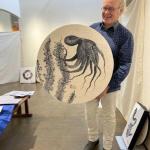
“I have also just completed some of the best salmon, albacore and giant Pacific octopus of my art career,” he said, “all of which will be in the show.”
About Heather Douglas
Heather Douglas is the editor of Coast Weekend and Associate editor at The Astorian. Born and raised in Astoria, she is an alum of Oregon State University and Pacific University. She enjoys reading, zine making, cooking and her favorite place to be is in the forest hiking with her husband and dog.
 More by Heather