Clatsop County youth up against social media addiction
Published 12:18 pm Monday, February 23, 2026









Mental health and physical abilities can be affected
Recent litigation surrounding social media companies and addictions among children call into question the local impacts of sites like Instagram and YouTube on Clatsop County kids.
Zuckerberg in court
In Los Angeles this week, Mark Zuckerberg faced the music in court where he testified about child safety in front of a jury for the first time. According to National Public Radio (NPR), over 1,600 plaintiffs, including hundreds of families and school districts, accused Meta, YouTube, TikTok and Snap of intentionally designing social media platforms to addict young children.
The trial that took place this week focuses on a 20-year-old woman who says addictive social media platforms, what people are calling “digital casinos,” worsened her mental health as a young girl. TikTok and Snap settled with the woman before the trial, but Meta and YouTube aren’t backing down.
The tech companies’ lawyers contend that the industry has been blamed for the complex emotional issues children face, which they say are caused by a combination of many factors.
Growing pains
Parents and teachers have increasingly expressed concerns over negative impacts of screen time and social media use on kids’ mental health.
One Seaside mom, who requested to go by her initials, N.M., out of fear of retribution, said children are not emotionally or mentally prepared to handle the pressure, exposure and risks of the online world, which can leave long-lasting emotional scars. “Childhood is short, but its impact lasts a lifetime,” she said.
According to the National Institute of Health (NIH), up to 20% of kids and teenagers deal with social media addiction, which entails excessive and compulsive usage that affects daily functioning, including relationship-building and learning, and overall well-being.
“When a child spends hours in front of a screen, they’re not just losing time,” said N.M. “They’re losing opportunities to grow, explore, imagine, and connect with others.”
Astoria High School (AHS) Principal Lynn Jackson said social media addiction, like many dependencies, exists on a spectrum, “from those who have a modest tendency to check their phone often, to those who truly feel like they are missing a significant part of themselves if they do not have access to their phones.” “And I have witnessed students along the entirety of that spectrum,” Jackson said.
The NIH characterizes social media addiction as a vicious cycle, alleging that kids with anxiety, depression and low self esteem are more likely than those without mental illness to use social media as a coping mechanism. However, classic struggles of peer pressure and social comparison compounded with tech companies’ carefully designed dopamine-driven feedback loop tend to worsen mental health.
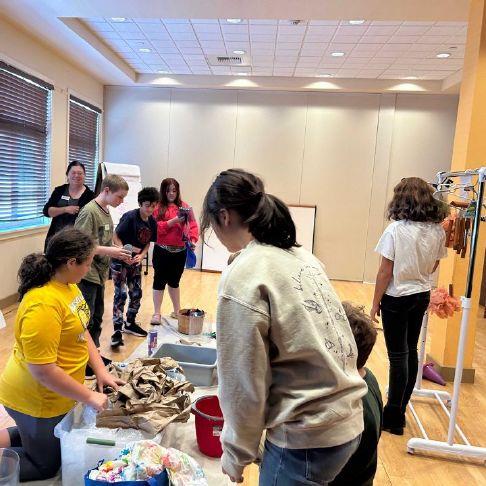
In addition to mental health concerns, Hilary Adams, Program Director at Kids Make Theatre (KMT), said she’s even seen some of her 3.5 to 5 year-old students struggle with fine motor development, particularly with hand muscle strength and coordination. Kids Make Theatre is a youth theater education program housed at the Liberty Theatre.
“They can swipe screens with ease, but struggle with age-appropriate tasks like using child-sized scissors (under supervision) and drawing using markers and crayons,” she said. “When young children spend significant time on screens, they’re training their brains to seek constant stimulation and immediate rewards rather than developing patience, focus, and the ability to engage deeply with physical, three-dimensional experiences.”
Finding solutions
The situation sounds dire, and it may be, but there is hope.
Adams said many of her students show tremendous enthusiasm for engaging with physical objects when given the opportunity. “They loved exploring an old-fashioned typewriter and were amazed by how much strength it took to type,” she said. “Locks with keys and combination locks required practice — at first, they tried pressing them like buttons!”
Redirecting screen time to play time may be the key. The Beth Israel Deaconess Center reported that 80% of participants who tried a weeklong social media detox reported improved mental health.
Even in an era of decreasing attention spans, Adams has witnessed consistent patterns with her students, who are able to engage fully for extended periods. “What we’ve found fascinating is that once we walk students over a metaphorical threshold into a creative, imaginary world of story creation, they become remarkably present and focused,” she said.
Michaeleen Doucleff’s explanation in a recent New York Times opinion piece seemed to resonate with Adams. Doucleff, who has a Ph.D. in physical chemistry, said devices trigger “constant wanting and desire” and leave people unsatisfied regardless of how long they scroll the web.
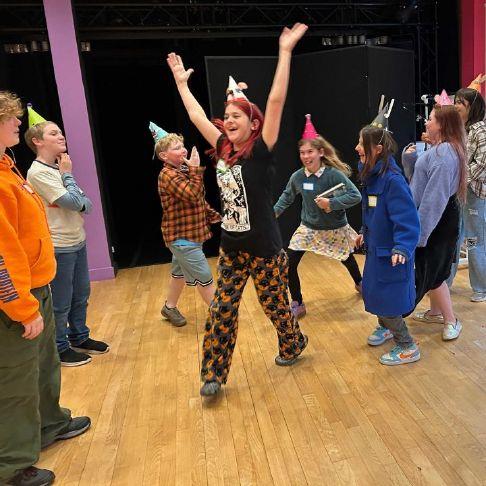
“At KMT, we’re actively working to break that cycle,” said Adams. “We’ve found that when we offer something genuinely engaging, with positive in-person social connections, students are eager to join in.”
This is something Jackson has been working on at the high school. Since the school started transitioning to be a personal electronic device-free school, Jackson said the school has open gyms at lunch and physical social games and puzzles.
Following Governor Tina Kotek’s executive order no. 25-09 last year, AHS has been completely device-free for students since Jan. 5, 2026.
Jackson said the policy change has been more seamless than he and his faculty expected. They have seen about a 30% reduction in cell phone confiscations since the policy changed to a full prohibition of phone use during the academic day, according to Jackson.
“In a sense, it’s been liberating,” he said. “If everyone within your social circle is in compliance with the expectation of having their cell phones silenced and secured, then you don’t have to worry about the fear of missing out concept because everyone is behaving the same way that you are.”
Adams said success comes from making boundaries clear. Telling her students “this is a different kind of time, a different kind of engagement,” helps them jump in.
N.M. said it can be difficult for parents, exhausted from their other responsibilities, to set these boundaries. “Its not a lack of love; it’s fatigue,” she said. Many parents turn to devices as a quick way to keep their children entertained, but N.M. said the temporary fix ends up causing long-term problems for their kids.
“It’s not about banning technology, but balancing it,” she said. “It’s not about being perfect parents, but present ones.”