Editor’s Notebook: Astoria Businesses Were Some of the Coast’s First
Published 6:09 am Friday, February 6, 2026
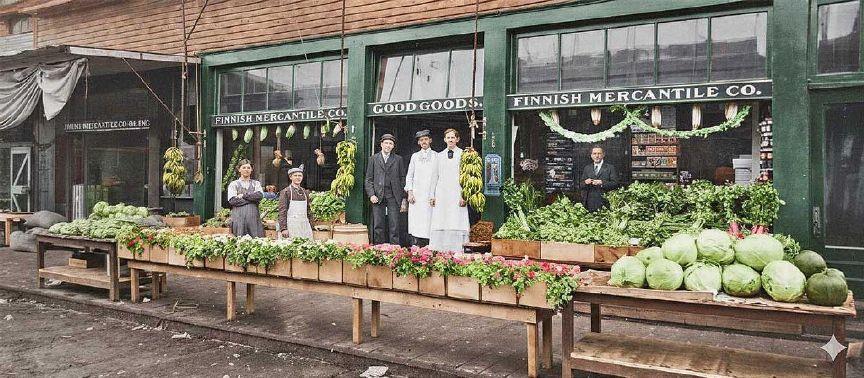



Reading the story reproduced here from our 1973 centennial edition, I was reminded of my admiration for two descendants of Astoria’s foundational business families — Willis Van Dusen and the late Skip Hauke.
Since I’m a newcomer with merely 35 years in the lower Columbia region, I can’t claim anything more than a passing acquaintance with the two. Willis gave me a generous interview as he was wrapping up his historic terms as Astoria mayor and I got to know the Skip during his years leading the Astoria-Warrenton Area Chamber of Commerce. Smart, hardworking, friendly and intensely devoted to their hometown are words that equally apply to each.
The continuity here over many decades of the Van Dusens and Haukes speaks to an aptitude for rolling with the punches and opportunities that circumstances deliver to all businesses. Hauke played a particularly active role in establishing Clatsop Economic Development Resources (CEDR), which plays a vital role in helping launch would-be entrepreneurs on paths toward success. This cultural environment of mutual support, of lifting everyone one, sets Clatsop County apart from many less successful places.
The following article and its accompanying illustrations lean on artificial intelligence, a technology poised to reshape many aspects of the local, national and global economy. This transformation, still barely at its inception, will test everyone’s ability to keep up.
•••
By VERNICE BERG of The Daily Astorian
Published in the newspaper’s 1873-1973 centennial edition
There were 10, maybe 12, families living in Astoria when Adam Van Dusen arrived in 1847 and set up his mercantile store, his insurance agency and became Wells Fargo agent.
The business now operated by his grandson Bill Van Dusen is, at 124 years, the oldest insurance agency on the Pacific Coast and is thought to be the first one west of the Mississippi.
When Adam Van Dusen arrived with his wife Caroline, the couple first lived on a land claim on the Wallacut River, then moved to Youngs Bay.
In 1849 they moved into Astoria — which had a grand total of two frame houses at the time — where they lived in the so-called Shark house.
It was built by sailors from the wrecked vessel Shark and was said to be a poor house, though Van Dusen’s rebuilding efforts succeeded in making it a comfortable dwelling.
The Van Dusens were the first in the area to sell their general store goods from the shelf rather than from boxes.
VAN DUSEN, DESCRIBED AS A person with keen salesmanship ability, was complemented by an equally able wife. Mrs. Van Dusen, it’s said, once agreed to sell for five pounds of butter a bonnet she had made. The purchaser promised to reimburse her soon, but didn’t realize that California gold mines were raising the value of money.
When the purchaser finally paid Mrs. Van Dusen, butter had gone from 25 cents per pound to $1.50 per pound.
Van Dusen operated all three businesses until he died. When his sons Brenham and Hustler G. Van Dusen took over, they sold the mercantile section and the Wells Fargo section, retaining the insurance business only.
Lloyd Van Dusen joined his brothers in running the family business and operated it himself after they died.
The 1922 fire wiped out his office building, though he was able to save the firm’s policy records.
Lloyd Van Dusen sold the business to his son Bill in 1940. Bill Van Dusen now owns the insurance agency and a beverage bottling company he purchased in 1948.
WHILE THE VAN DUSEN INSURANCE Agency is said to be the oldest one on the Pacific Coast, the wife of the first Lutheran circuit rider established the first trust and savings bank in Upper Astoria.
Mrs. Emile Christensen, whose minister husband helped establish the Norwegian Lutheran Church (First Lutheran), has written this account of how she helped Scandinavian fishermen safeguard their money:
“It may be of interest to my Astoria friends to know that we started the first Trust and Savings Bank in Upper Astoria. It was right in our home and was ‘trust and savings’ in the true sense of the words.
“Trust was the feeling the depositors had toward us, a confidence we much appreciated, and the savings were the small earnings of the fishermen, which they placed with us for safekeeping.
“I took care of the vault, which was a small walnut box that was kept in my Dakota dresser. I kept the key. The bank rules were: each depositor had his roll of bills wrapped carefully in paper with his name and the amount contained written on the roll. The other rule was silence.”
ED ROSS, WHOSE FATHER AND grandfather came to the Lower Columbia area from Finland, offers another view of early banking in Astoria.
When asked if it was true that the Finnish people hoard money other than in banking institutions, Ross replied:
“The Finns brought (in addition to the sauna) a kind of bullheadedness and community frugality to America. Astoria is a frugal town. You have to remember that some Finns have gone through three or four big bank failures.
“People here distrusted paper money, too — the silver dollar circulated here and in other parts of Oregon and in Washington far longer than in other areas.
“And there was no branch banking at the time. Banks were local banks and sometimes headed by persons with no real banking experience.”
In addition to Mrs. Christensen’s home bank there’s another Uppertown business that was established in 1890 and which is still going strong.
Hauke’s Market has been doing business in Astoria at the same location for 83 years. Eric Hauke, who owns it now with his sister Olga Henningsen, believes it to be the oldest grocery store in Oregon being operated by the same family.
HAUKE’S FATHER ERICK WAS A native Norwegian who came to Astoria after the fire of 1883, which destroyed the downtown business district.
He and W. Scholfield established the first firm, Scholfield and Hauke, which dealt in groceries, meats, hay and feed, hardware, crockery, fishermen’s supplies and assorted sundry items.
In 1915, during an attempted burglary, the store caught fire and burned and a temporary store was established in the adjacent Idun Hall.
When the store was rebuilt it included a new feature — refrigeration. Prior to that time there was no refrigeration for foods in Astoria markets.
Once the automobile became an integral part of the Astoria scene the Uppertown firm discontinued its horse and wagon deliveries.
At one time there were four drivers who toured Uppertown and Alderbrook in the morning, returned to the store, where the orders were filled, and then delivered the goods in the afternoon.
SHORTLY AFTER COMPLETION OF the new building in 1915 Erick Hauke died in a car accident. Subsequently his heirs controlled a half interest in the business which included part owners Adolf Hauke, Paul Hauke and Andrew Ness.
Various members of the firm have sold their interests in the business over the years, leaving members of the Hauke family the sole owners. Eric Hauke, son of the store’s founder, became manager of the store in 1941.
The 1915 building has been remodeled three times and now houses a modern supermarket.
Another family business that still is operating — but in downtown Astoria — is Andrew & Steve’s Cafe.
Steve Phillipakis first thought of leaving Crete, Greece, when his uncle returned to the island and reminisced about his years as a fisherman on the Columbia River.
Like many newcomers he didn’t come to Astoria immediately but worked on railroad gangs, on construction jobs and in sawmills elsewhere.
It didn’t take him long after arriving in Astoria in 1912 to get his first taste of the restaurant business. But before he established a place of his own he, like other members of 9th Co., Oregon National Guard, were drafted to serve in the Army during World War I.
WHEN PHILLIPAKIS RETURNED FROM his Army stint he leased space for his first place — Middleway Lunch.
Later, he and Andrew Cetina, a Slavonian, started the original Andrew and Steve’s in a wooden building near the present Ed Fearey Insurance Agency.
After the 1922 fire that destroyed so much of the city’s business district, the partners started a new Andrew and Steve’s in a concrete structure on what is now Marine Drive.
Phillipakis retired in 1965, two years after his partner’s death, and turned over the business to family.
A new modern restaurant was built shortly thereafter and does business now at 1196 Marine Drive.
It’s said that another Astoria business — that of Foard and Stokes — probably was the first firm to change from a frontier to a more up-to-date style of doing business in old Astoria.
FRANK R. STOKES APPARENTLY HELPED in the process of changing the handling of the creamery business from the farm to the central plant; and his store, it is said, displayed and sold the first cream separator made in the U.S., as well as the first steel range.
Prior to that, only cast-iron cooking stoves and brick ranges were in use.
Stokes is also said to have stocked the first typewriter and adding machine, and in a venture far removed from business machines, was active in pushing the use of the cold storage plant.
Stokes’s partner, Martin Foard, divided his attention between cannery matters and shipping activities.
Foard helped create the Alaska Packers Assn.
Most of the sailing vessels and later steamers that were wrecked on the ocean shores and rivers from Grays Harbor, Wash., to Tillamook were bought by his firm.
The vessels were stripped in many cases and salvage items were sold to other ships.
One account of Foard’s performance goes like this: “It takes sea knowledge and nerve to be a wrecker and the frontier sea daredevil has a chance to display his talents.
“If anyone deserved the title of captain through ship ownership, then he was surely a captain.”