Water under the bridge for Jan. 27, 2026
Published 8:24 am Monday, January 26, 2026
Compiled by Bob Duke
From the pages of Astoria’s daily newspapers
10 years ago — 2016
When the men and women of U.S. Coast Guard Sector Columbia River came to work Monday morning, they were told they had 20 minutes to reach Fort Clatsop.
In a Cascadia Subduction Zone earthquake, 20 minutes is about all the time residents would get to find higher ground.
For the evacuation drill, about 100 members left their posts near the Astoria Regional Airport and ran 1.4 miles to the fort in Lewis and Clark National Historical Park, where the Coast Guard would set up an incident command center in an actual emergency.
The evacuation drill was staged the day before the 316th anniversary of what scientists believe was the last large Cascadia earthquake and tsunami on Jan. 26, 1700.
The National Parks Service is partnering with citizen scientists to track when plant species flower, leaf out or set seed. The way plants grow gives clues to changes in the environment and the impact of climate change.
“Plants, as we know, have the most sensitive biological responses to climate change,” Nancy Fernandez, a climate change intern with Lewis and Clark National Historical Park, said. “They are sensitive to temperature change and precipitation.
Fernandez discussed plant responses to climate change during a talk last week at Fort George Lovell Showroom in Astoria.
As a native of California’s Central Valley, Fernandez said, she has seen firsthand drought conditions and plants blooming earlier each spring.
CANNON BEACH – A 10-foot tall welcoming pole in the figure of a Clatsop tribesman may soon be installed in NeCus’ Park at the former Cannon Beach Elementary School playground.
The city arts advisory committee has recommended that its annual $10,000 grant for public art be spent on the statue, to be carved from a cedar pole. Before the pole is formally commissioned, however, it must be approved by the city’s design review board, which will consider it in February. City Manager Brant Kucera will have the final say about whether the statue should be purchased.
The pole will be carved by Quinault, Washington, artist Guy Capoeman, who has carved other poles and canoes, Some of Capoeman’s relatives belong to the Clatsop, Nehalem and Tillamook tribes, according to Dick Basch, vice chairman of the Clatsop-Nehalem Tribe.
ILWACO, Wash. – On Monday morning, funeral home owner Ron Hylton shook his head as he stared down into the enormous hole where the “Fourth Addition” section of the Ilwaco Cemetery used to be. A few inches from his feet, the ragged edge of the cemetery lawn slumped over the edge of a sheer drop-off. Yards below, a headstone rested in a field of mud that was the color and consistency of butterscotch pudding.
“We can’t leave this. We’re gonna have to fix it somehow,” said Hylton, who is one of the five members of the all-volunteer board that manages the cemetery. Hylton said he and other cemetery caretakers are actively working to address the damage caused by a landslide Thursday. However, he cautioned that fixing the cemetery could be a slow, complicated and expensive project.
50 years ago — 1976
Bumble Bee Seafoods cannery here will shut down for possibly four weeks this Friday because it has run out of tuna to pack.
“We have enough tuna to pack through Friday, but that’s it,” a Bumble Bee spokesman said today. “As soon as we get more fish we will start up again, but that probably won’t be for about four weeks.”
The Bumble Bee cannery has run at full strength since the first of January. When the plant goes down, it will idle more than 500 workers.
Jim Rzegocki’s seventh grade students at Star of the Sea School are finding themselves pleasantly surprised at how well the current class project is coming along – in more ways than one.
The seventh grade students are working with Nancy Wahlbom’s kindergarten class to make a new kitchen “sink” and “stove” for the kindergartners and the wooden structure is beginning to take shape.
But more than the project itself, the seventh graders are finding that they enjoy working with the younger students and take pride in creating something with their own hands.
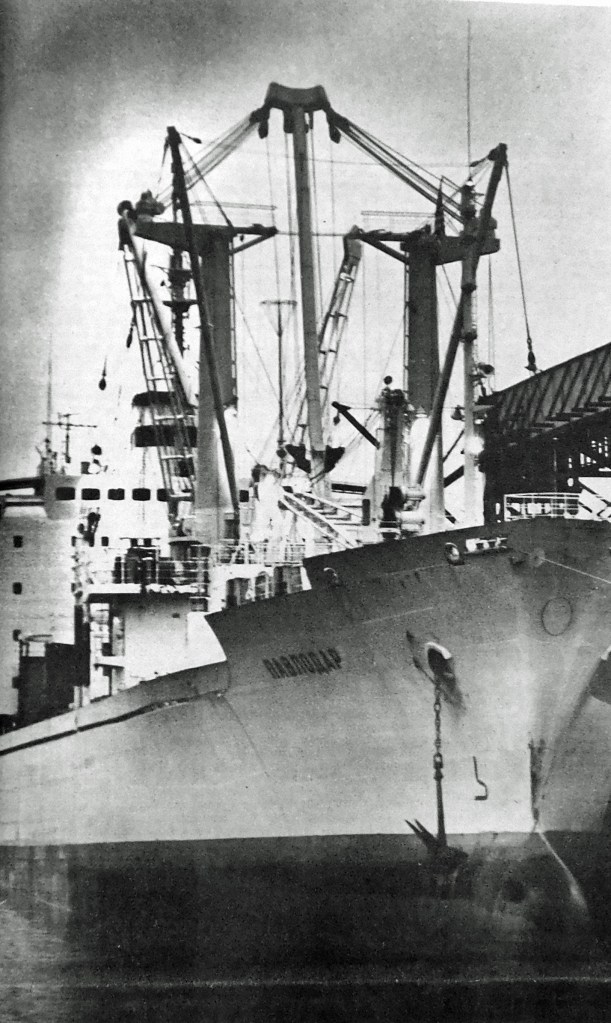
A year-old Soviet freighter loaded with grain at Astoria Monday as part of its first series of visits to U.S. ports.
The Pavlodar, built in East Germany and operated by Far Eastern Shipping Co., (FESCO), of Vladivostok, USSR, has become part of FESCO’s fleet of ships carrying cargo across the Pacific Ocean.
Two years ago Timothy Logan and his sister Lenee of Astoria became United States citizens. Both were adopted at an early age by Dick and Donna Logan.
At the time, Timothy, then 15, expressed his views on a number of subjects, including politics, and said that many people don’t understand that it’s possible to criticize the government and remain patriotic.
Logan said then that the responsibilities of citizenship were just as important as the privileges and that he felt it was important for him to take an energetic role in community life, which meant voting and using existing channels to express views.
WESTPORT – A 95-car Burlington-Northern train loaded mostly with grain and bound for the Port of Astoria derailed at 7:15 a.m. today one mile west of Westport.
Ten loaded cars left the track when a wheel mount apparently broke on the fourth car in the train, said Ed Butler, company trainmaster from Portland who is supervising clean-up operations. Some 500 feet of track was uprooted and wheat and barley were strewn amid the mud and twisted and bent wreckage.
“You are never broke with me” is the slogan on a coin issued several decades ago by the North Pacific Brewing Co. of Astoria. One of the brewery’s coins was worth a beer at local saloons, and the patrons spent them with pleasure.
In the old days of Astoria, coins like that were almost as common as quarters, because many businesses minted their own forms of money. They were known as “checks,” “bingles” or “hickeys.
There still are a couple of establishments which carry on the tradition by giving their customers wooden tokens good for merchandise, but the practice has for the most part been abandoned.
Abandoned, but for at least one Astorian not forgotten. That Astorian is Jon Aho, a 25-year-old Public market meat cutter who has collected more than 100 different types of tokens in the past year.
75 years ago — 1951
Reinstatement of a ship repair program that was suspended in August 1949 at Tongue Point Naval Station is expected in the very near future, naval authorities there predicted today, although they could not set a definite date.
However, a two-ship repair contract will be started at once to prevent the local labor supply from drifting away before the main program gets started.
The ship repair program to be reinstated provides for routine overhaul of each reserve ship in the Columbia River group every five years.
The program was in operation several years before it was cut off in 1949 as an economy measure. When in full operation, it provided a contract for 30-odd ships every six months, employing about 250 civilian workmen.
It is possible that the reinstated program will move at even greater volume, naval authorities believe, due to the pressure of events abroad.
A cold east wind sent temperatures down to below the freezing mark in some part of the county and short snow flurries were reported this morning.
The Cape Disappointment Coast Guard Station reported a low of 26 degrees at mid-morning today and Warrenton and Hammond had about ½ inch of snow on the ground.
Columbia River salmon fishermen need not worry about any danger that the fish they catch will be radioactive and therefore dangerous to eat.
This was the word obtained for the Astorian-Budget by Arnie Suomela, master fish warden for the Oregon fish commission, from the biology division of the General Electric company’s nucleonics department at Hanford, Wash.
In a letter to Suomela, Richard F. Foster, aquatic biology group head of the GE company’s Hanford health instruments division, declared that an article in the December 25, 1950, issue of Time magazine created an “erroneous impression” regarding the amount of radioactivity in Columbia River salmon that hang around the Hanford atomic works.
“While some radioactivity is present in the fish inhabiting the Columbia Rive immediately below the Hanford project,” he declared, “the amount which is considered safe even for humans.”
A tug and a pleasure cruiser were safely in port today after the coast guard answered distress calls from the vessels off the Oregon coast Sunday.
Both boats were assisted to safety by coast guard vessels after a coast guard patrol plane from Port Angeles located them.
Local coast guardsmen said the tug Peggy Bell, owned by the Russell Family Inc., Portland was in trouble off Grays Harbor.
The coast guard said the Peggy Bell, a new boat on its maiden run, had left Seattle for Portland. After the boat got out to sea the crew discovered that the gear ratios were not sufficient to operate the rudder in heavy swells.
The motor lifeboat Triumph from Point Adams, and Invincible from Grays Harbor, were dispatched to the aid of the tug but were unable to locate it. The plane then spotted the boat and sent the Invincible, which was closer to the scene, to aid the tug. The Invincible escorted the tug safely into Westport, Wash.