Editor’s Notebook: Treasuring the shallow joy of collecting
Published 7:41 am Friday, January 23, 2026
David Campiche’s Seaview home reminds me a little of the Paul Revere house in Boston — an inanimate old space infused with life by the energy and creativity of its occupants.
David and Laurie’s residence contains a far more eclectic saturation of good taste than anything Revere could have managed on a colonial silversmith’s income. It could be a character in a book — maybe not a magical portal as in “The Lion, the Witch and the Wardrobe” — but a complex and embracing personality that befriends anyone who comes through the door.
Like me, David and Laurie belong to a very nonexclusive club. We are collectors — mostly of stuff other people aren’t terrifically interested in.
Quite often lately, I’ve been pondering the act or hobby or obsession of collecting. It’s been a lifetime fixation, but the Jan. 30 opening at Columbia Pacific Heritage Museum of an exhibition of my rather silly passion for old salmon can labels has caused me to reconsider why we gather the possessions we do.
Actual silver coins were still in circulation when I was a boy. Mercury dimes dad gave me from pocket change were my first collection. From there, it was 10- and 12-cent comic books. I think maps came next, followed by first-edition books.
Much of this has been shed over the decades. I’ll always kick myself for selling that perfect “Grapes of Wrath” and my mother proudly unloaded about a thousand comics for a hundred bucks at a garage sale.
But I still have an embarrassment of objects. They weigh me down but I love them anyway, fawning over some newly acquired label like Gollum petting his “precious” ring in a subterranean cavern. And then the immediate thrill passes and I’m on a quest for the next one.
Psychology of stuff
According to an article by Shirley M. Mueller, M.D. in the October 2020 edition of Psychology Today, “Around 33 to 40 percent of the American population collects one thing or another.” I might have guessed a higher number.
Like magpies compelled to pick up shiny chewing-gum wrappers, one possible explanation for why we collect is demonstrated by the aptly named “Oddball experiment.” Subjects’ brains light up when a string of ordinary objects is interrupted by something more extraordinary.
“This may be why we seek the unique when we collect. It stimulates our brains in areas that connect to our pleasure center,” Mueller writes.
Like my delightful Aunt Lucille in West Seattle, some collectors are driven by memories of scarcity. Having grown up in lean Great Depression times, she amassed so many cookbooks and gourmet magazines that parts of her house were literally impassible. Grandaunt Lillian’s motivation was “pride in acquiring exquisite objects. This is heightened by gathering like items together for the first time,” according to Mueller’s article. Lillian and her husband doted on 20th century abstract paintings and sculptures.
Local stars
One of our greatest local collectors was Michael Foster, who died in 2016. We said of him at the time that walking into his 6,500-square-foot Victorian home in Astoria was like entering an international art museum.
“Asked in 2009 how many pieces of art he owns, he said, ‘3,600 have been catalogued.’ There are more, but he doesn’t know how many.” And, “About his obsession with collecting, Foster said, ‘It’s like a disease. It’s similar to alcoholism, except you feel better.’”
Foster himself paid tribute to Bob Drucker, who died after a lifetime of generosity and kindness: “He was a great archeologist. He explored the Indian Mounds in Seaside for the Smithsonian.” His collection of Indian baskets and other Indigenous objects was considered inspirational.
On a more down-to-water level, my late friend Clarence “Snooky” Barendse of Knappa, who passed away in 2004, was an advanced collector of vintage waterfowl decoys. I recall being amazed by his success in collecting Charles Bergman (1856 – 1946), an Astoria decoy carver of national renown. Clarence also amassed an impressive label collection, now in his daughter’s safekeeping.
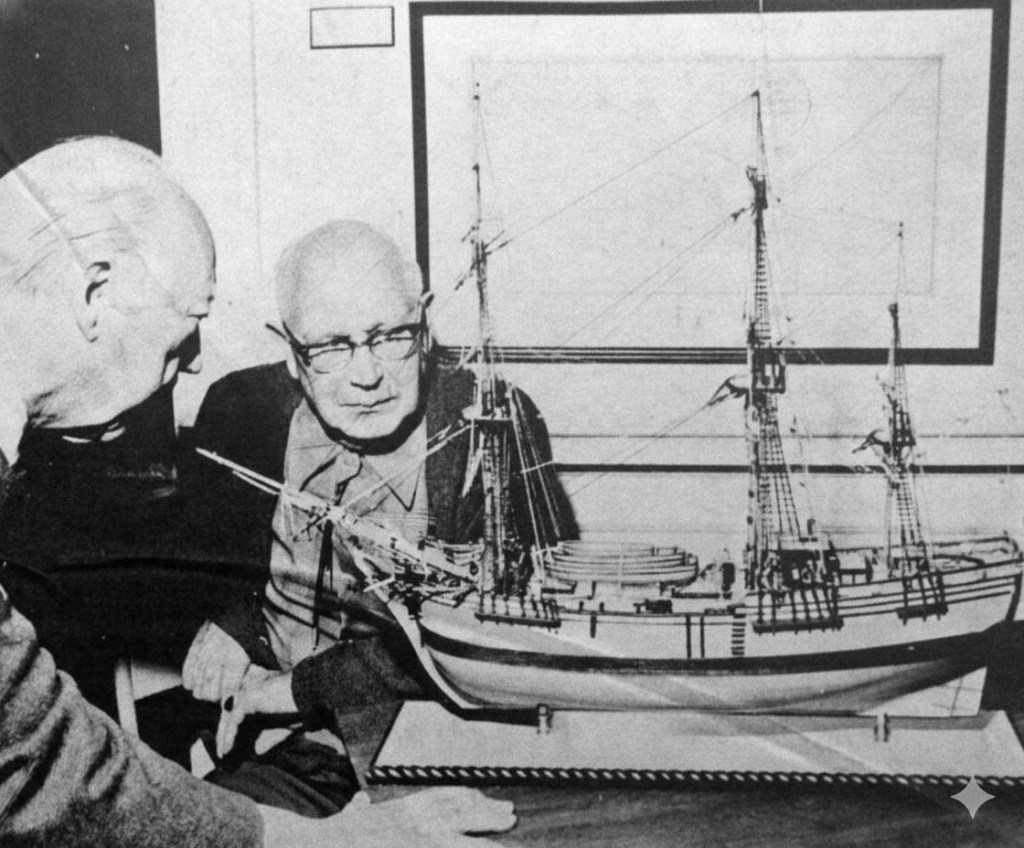
There shouldn’t be much debate that Rolf Klep was the king of Lower Columbia River collectors; his maritime artifacts underpin the Columbia River Maritime Museum. Klep demonstrates the sad truth that eventually dawns on most who decide to pursue any collecting hobby: No matter what you’re fascinated with, chances are excellent that somebody else — Klep, in the case of cool ship artifacts — has already hoovered up many of the best items.
Although I’ve focused this on stereotypical “boy” stuff — and don’t even get me started on the Ilwaco railway, early marine engines and outboards — some women are every bit as obsessive. My creative wife Donna is a perfect example of the fact that buying yarn and beads is a totally different hobby than actually making them into something. She just loves the colors. If a comet hits the earth and civilization reverts back to a bead-based economy, we will never go hungry.
Let it go
Ironically, I’m also a fan of not clinging to things. We find our most profound joy in other people and living creatures. Everything else — all the things we fuss over and covet — is mere entertainment and distraction. To that point, I was recently struck by these wise words from poet Mary Oliver:
To live in this world
you must be able
to do three things:
to love what is mortal;
to hold it
against your bones knowing
your own life depends on it;
and, when the time comes to let it
go, to let it go.
Matt Winters is regional editor of The Astorian, Chinook Observer and Seaside Signal. For more about the label exhibit, see https://tinyurl.com/Curator-Labels and https://tinyurl.com/Winters-Labels