Jay Corella, quite the fella
Published 11:09 am Friday, January 16, 2026
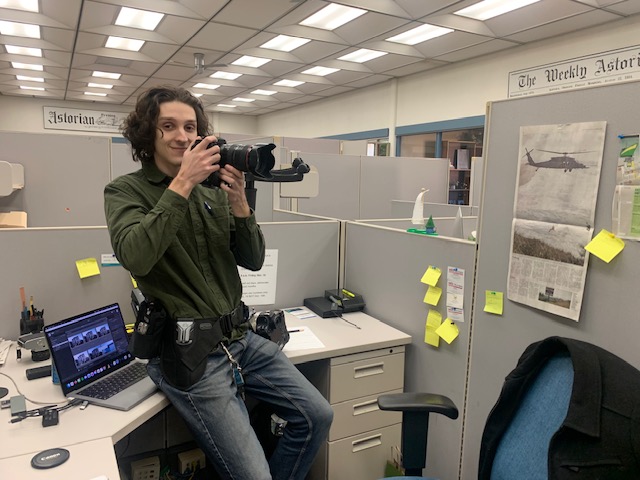
Meet Jay, the newest member of our team
Jay Corella’s first day at The Astorian was Oct. 20. He is our newest reporter — and he’s also a photojournalist. He’s a product of the University of Arizona School of Journalism and served as the multimedia editor of The Daily Wildcat, the school’s student newspaper, where, among other duties, he managed a team of 12(!) photographers.
Introducing him to you is long overdue. And so, without further adieu, I present to you: Jay Corella.
I sent Jay some questions which, I think you’ll find, he answered with panache. And what I am sure of is — you will find out more about the newest member to our team, as I did, when you read the following Q&A. It has been gently edited.
Jay, you graduated from the University of Arizona last May with a bachelor’s degree in journalism, with a focus on multimedia journalism. Can you talk about what drew you to journalism — and why you chose multimedia journalism as your focus?
My initial draw to journalism came because of my love for photography. I took a liking to film photography in high school and figured I wanted to make photography a job. Naturally, I figured that photojournalism would be an avenue that I would like to explore.
Through college I spent my time focusing on photojournalism and was fortunate to have good mentors along the way. The nature of photojournalism in a more modern context is that it has shifted into multimedia work in broader terms — photographers are now photographers, videographers and producers rolled into one.
Arizona was a perfect proving ground for this because being a large school in a healthily sized media market. I also got lucky having the 2024 election cycle fall into my lap during my senior year.
You also minored in linguistics — how has that affected your journey, has it helped you hone your story writing skills?
That’s a very common misconception about linguistics. Linguists broadly don’t think about writing systems. Linguistics specifically refers to spoken language, and my specialties, semantics and syntax looks deeper into the mathematics of language.
The real reason I chose linguistics is because foreign reporting is the field that I’ve wanted to be in. Rather than pigeonhole myself into learning a single language, or family of languages, I thought I’d just learn how all languages work.
Linguistics studies the frameworks of languages rather than any individual one. I figured that would make sense to study seeing as I wanted to work in places with great levels of linguistic diversity. For a few examples in North Africa, there are almost 400 languages spoken daily, and in India the region is home to almost 20,000 languages and dialects, and 22 official languages.
Linguistics is a very interesting field because it provides the basis for us to understand how language works in very broad terms. While I’d be hesitant to say that it has made me a better writer, it has given me a new approach to learning about languages and cultures.
Who or what has inspired you — and why? Details, please.
There are a few photographers and reporters that I know of that have certainly inspired me over the years. Namely, Larry Burrows, Horst Faas and Evan Wright.
I broadly credit Faas for being the person who made me particularly interested in photojournalism as a practice, his work with the Associated Press throughout the Vietnam War was always particularly inspiring. Burrows, of the same era, made me appreciate the photo essay and think about images as a storytelling medium. My favorite story of his, One Ride with Yankee Papa 13 in the April 16, 1965, issue of Life is one of my favorite photo essays ever made.
Evan Wright’s “The Killer Elite” did the same for me but more on the writing side. Long-term embedding work is very interesting to me; it’s inspiring to know that these things are within reach to reporters provided they want it enough.
There are also people in my life who have inspired me or kept me going. Rick Wiley, former photo editor of the Arizona Daily Star would be one of those people. He was always a great resource in college, to learn from the photo editor’s perspective, and he was always willing to tell me a photo I took was just bad. Fortunately, he didn’t do that very much.
If you were a superhero, which superhero would you choose to be — and why?
I feel like the natural answer to this should be Spider Man because of the whole photojournalist thing he has going on; on the other hand Batman doesn’t have struggling-to-make-rent as a regular plot point, so I’m inclined to go for that.
Being played by Robert Pattinson is also a plus.
What has been the most challenging moment in your life so far and why?
I will not pretend to have lived through any particularly traumatic life experiences or sudden and shocking family deaths. I think the most challenging moments in my life came in the course of my normal work. During my last year of college, I was trying to balance two jobs, an internship, freelancing every so often and a full courseload. In theory, there was also supposed to be a social life in there, somewhere.
That was arguably one of the larger challenges that I had to manage at the time: the social element of reporting. The irony of me being a reporter is that the social aspect of it never clicked for me, which if we interrogate that deeper is probably why I work so well behind a camera and not so well in front of one. For some people, the social aspect comes easily and that’s what makes them a good reporter. For me, I’ve felt like I’ve had to figure it out in the same way one might figure out how to build Ikea furniture without instructions.
Evidently, I managed and now I’m here.
You’re just starting out on your career journey. Describe your dream job, where is it located and why does it call to you?
My ideal job is working as a staff photographer for a wire service. I want the chance to work in the worst places in the world where nobody else is willing to go. Where this is, naturally changes with world events. Though the Middle East has historically been where reporters go for work like this, I’ve been very closely watching Southeast Asia. The region is currently host to multiple humanitarian crises, a civil war, and a slew of international conflicts, one of which has potential to erupt as soon as this year.
Now, the viability of this as a career remains to be seen, but the question was what my “dream job” was, not what my “ideal, but realistic position” is.
Favorite book, game, movie, food?
Book: That’s a tough one, “Blood Meridian” by Cormac McCarthy is a standout that I read in college. Around the same time, I was playing the Red Dead videogame series and living in Tucson, so I was getting the whole desert experience some way or another. I will say that I don’t recommend the book to most people since the violence in it is orders of magnitude more shocking than you think it will be. On the other hand, McCarthy’s prose about the desert is so beautiful it makes you appreciate the Sonoran Desert in ways you never thought were possible.
Game: “Halo Reach” was my absolute favorite video game growing up. It’s easily the best of the Halo series and has a cinematographic style that has absolutely influenced what I like and what I try to do with video work on the rare occasions I end up doing video. Plus, it’s hard to mention the game without mentioning the musical score which is in my eyes the best in the series
Movie: It’s hard to have a definitive favorite movie, I watch a lot of them, and I like a lot of movies for a lot of different reasons, but recently, I watched “Lawrence of Arabia,” and I think that it’s one of the best movies ever made. Granted, it’s also a movie that will occupy your entire day, but it manages to be a strong story all the way through. One of the more striking things about the movie, or rather, any movie of this nature, is that somebody had to experience all of it by themselves. However, if I were to recommend a movie that I particularly like to anybody, it would probably be “Waterloo.”
Food: In Tucson, the 4th Avenue Street Fair happened right next to my apartment twice a year. There’s a stall right next to the 5th Street Sunlink stop during the fair that has a bacon-wrapped tri-tip burrito. To my knowledge, they do not have a brick-and-mortar restaurant, likely because the world is not ready for that yet. The net of it is that I would only get to have it twice a year, but whenever they would set up for the fair along my street, I would instantly get excited since I knew that the next day, I could get access to the greatest burrito ever made. Interesting fact about Tucson is that it’s the first UNESCO-certified City of Gastronomy in North America.
What do you like to do for fun?
Recently, as I’ve moved back to Oregon, I’ve gotten into rock climbing. I try to stay very physically active so on weekends I often travel to Portland to go climbing. I’ve also tried to make an intentional effort to watch more movies, so as of late I’ve been watching the movies I missed over the years on account of not being born yet. “The Manchurian Candidate” is one that I really liked this week.
I’ve also stayed in tune with my love for film photography, so I’ve been in the process of developing a pair of 4×5 negatives that came from my Graflex, (an old press camera from the ‘50s) and I’ve been looking for a new film lab to process my color film.
In the future, likely to my housemates’ chagrin, I will be working on setting up a darkroom so that I can do my own prints at home (and get my enlargers out of my parents’ house).
Anything else you want to say.
I would just like to say that I am very excited to be back in Oregon and doing a job that I love. I love that every day I get to meet new and interesting people and learn more about a city I’m quickly growing to love.
I have no strong desire to talk about myself at length so I will end with saying that one of the best things that I can do as a photographer is to support everybody else in the newsroom by making their (and by extension my) articles more visually appealing. In my ideal world, a strong photo is what pulls somebody into an article and the writing keeps them engaged.