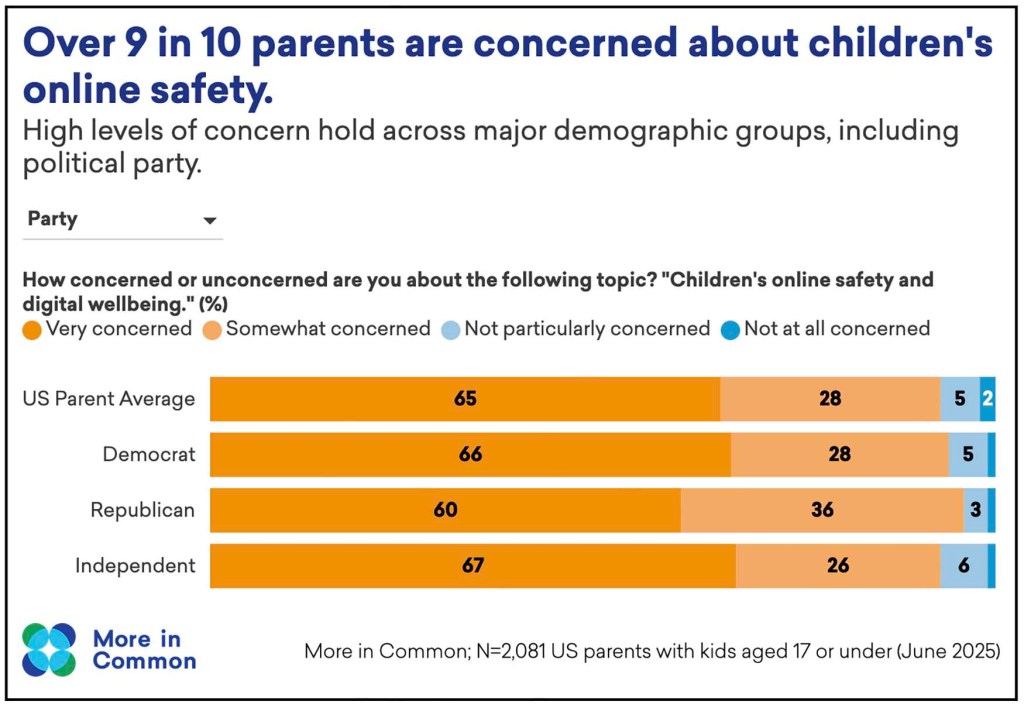
According to More in Common, which recently surveyed parents in the U.S., U.K., France and Poland on their thoughts and experiences around online safety, 65% of U.S. parents are “very” concerned about their kids’ safety online, and another 28% are “somewhat” concerned (leaving 7% of parents not that concerned at all — a troubling number, even if it seems low).
And according to the researchers, deeper focus group sessions showed many parents feel that other parents are undermining their ability to keep their children safe. Specifically, the researchers note that, “Differences in approaches between parents are seen as a source of tension, and a way for children to bypass the rules in their own household. This can lead to parents feeling powerless.”
Perhaps parents feel powerless because so often they are alone in this fight, given that the burden of responsibility for keeping kids safe online is lobbed squarely onto parents rather than onto the technology companies where it belongs.
This is not by accident, or by default, but is a result of the democratic process failing to protect the most vulnerable among us — our children — from Big Tech. When there is no corporate accountability, the result is infighting and an inability for civil society to form a strong, united front.
We are in a divisive time in this country, politically, but we must not be divisive on this issue, and changing community norms is one of the best defenses we have right now against the risks our kids are facing. We know child sexual abuse material can be found on every platform. We know social media is problematic for a multitude of reasons for kids under 16 (and even older). The online realm, especially now that AI has exploded with essentially no guardrails and major support from the current administration, is only getting crazier and more dangerous. AI toys are the newest threat and should make every parent lose sleep at night.
Certainly not all kids are the same — what one child can handle online might be very different for the next child. And parents are the best judges of that. But let’s be real — not all parents are diligent or, as the More in Common research shows, all that concerned about the mental and physical risks posed to young people when they go online.
We can be pro-tech and also pro-safety, but we have to be able to talk to each other and come to some agreement around what we, as a country, will allow for our children. But we won’t come to a consensus without first agreeing that it’s a collective problem with collective consequences.
There is legislation that will help to fight this problem and hold tech companies responsible for what happens on their platforms. And we must support this sort of policy action to get to the root cause. But as parents, the greatest power we have is our ability to come together. We must not let parental individualism get in our way of protecting our kids online.