Tariffs do the talking at Astoria Library event
Published 5:32 am Monday, December 15, 2025
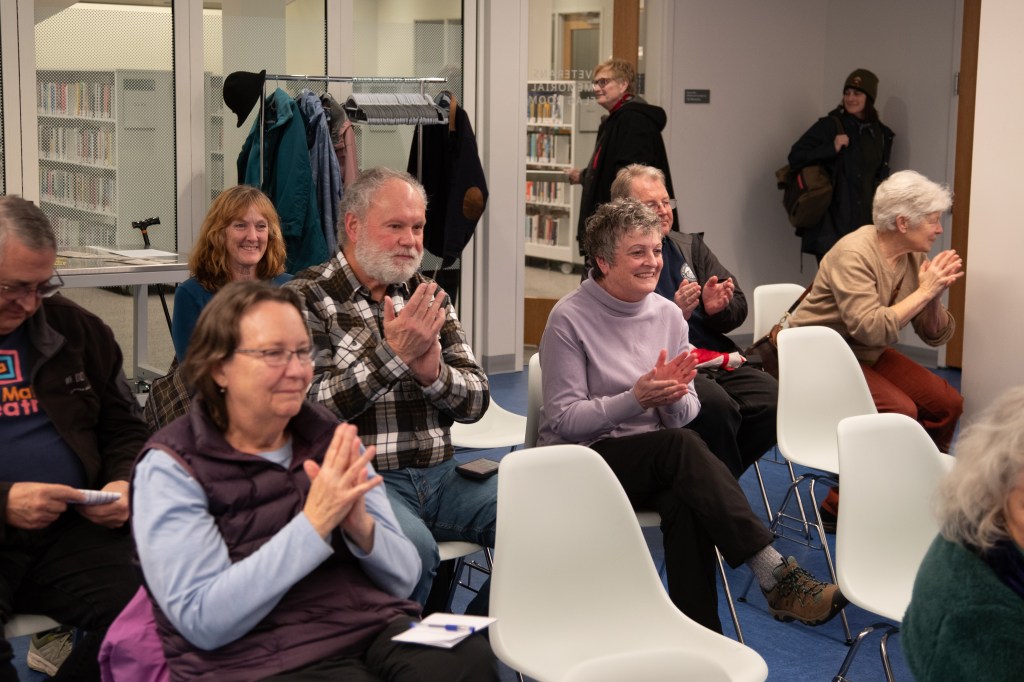
Astoria community listens and chimes in at ‘Tariff Talk’ event
By JAY CORELLA
The Astorian
At 5 p.m. on Wednesday, Dec. 10, about 25 community members met in the Flag Room of the Astoria Public Library for a “Tariff Talk” organized by Aretta Christie and Janie MacDonald.
The talks aimed to help businesspeople and community members better understand how tariffs may be affecting local businesses.
The talk started with presentations from three local businesspeople: Colin Cummings, a supply chain manager at Fort George Brewery; Saara Matthews, owner of Finnware in downtown Astoria; and Matt Stanley, general manager at Astoria Co+op.
Stanley went first and took on the grocer’s perspective on tariffs and how they are affecting their business. Stanley’s background is in nonprofit operations and has served as the general manager of the co-op for about 18 years. He holds a master’s degree in nonprofit and economic development from the University of California San Diego.
“Tariffs, in my view, are ultimately a hidden tax on small businesses and consumers,” said Stanley.
Stanley said that small businesses thrive on stability. From the co-op’s perspective, when their prices increase, their margins dictate that the price increases must be passed on to consumers.
“What we’ve gotten really good at doing is staying on top of price updates,” said Stanley. “It’s not fun work.”
Beyond just creating challenges for grocers, the price changes negatively affect consumers, he said.
“(Tariffs) really create instability for our customers,” said Stanley. “We all as shoppers have gotten used to that over the last five years where food costs are up 20% since 2020.”
Stanley closed his presentation by saying “it’s not a fun position to be in –– waiting for monthly price updates that are coming at a pretty fast clip.”
Matthews followed and took on the perspective of an importer. Her business, Finnware, imports almost all of its products.
“The Nordic countries all have a 15% tariff on them,” said Matthews.
However, a second issue now affects her imports — duty costs — which are a different type of import tax levied on top of tariffs.
“If we imported something under $800, there were no duty costs on them. Now,” said Matthews, “everything is getting a duty cost and it seems like it’s increased.”
She said that if she imports $1,000 worth of goods which would already incur the default 15% tariff, she would also face a $190 duty charge.
“I can only absorb so much,” said Matthews, “so I’m going to have to pass that on to my customers.”
Matthews said that at least one of her vendors is holding off on raising prices, but in 2026 they will rise sharply to adjust to the new tariffs.
“My fear is that we will get priced out where we cannot stay, people won’t be able to afford it,” she said.
Matthews closed her presentation by reiterating that “everything is affected by (tariffs).”
Cummings of Fort George Brewery closed out the presentations by looking at the tariff perspective from a brewer’s standpoint.
Cummings opened by saying that American craft breweries are largely insulated from tariffs because most of the hops and barley that Fort George uses in making its beer are either grown domestically or covered by the United States-Mexico-Canada Agreement.
“The biggest impacts are going to be in aluminum and steel,” said Cummings.
He said virtually all beer is packaged in aluminum cans or stainless-steel kegs, so metal commodity prices are the biggest factors in price hikes within the beer industry.
“All the equipment we have is manufactured in the United States,” said Cummings, “but different kinds of steel … to build those tanks could come from all over the world.”
Another challenge is aluminum. Cummings said there is no American company making it.
“Our can supplier could be buying aluminum sheets from four or five countries at any given time,” he said.
On the consumer end, Cummings said that beer prices have not seen a heavy shift in the last five years. However, he warned that in the coming years those price hikes may be coming.
The Q & A
After the presentations, there was an open forum for questions.
Megan McFeely-Wong was first, asking if prices could ever return to pre-tariff levels.
“You don’t see prices go down a lot,” said Stanley, “so I’m not holding my breath for that.”
Pastor Bill Van Nostran asked Cummings if he had heard of any sheet aluminum mills starting in America as a response to the tariffs. Returning manufacturing to America has been a stated goal of the Trump administration.
Cummings said he had not heard of sheet aluminum mills starting domestically.
“(The tariffs) allay some fears for the naive who don’t understand that the tariffs are a tax, and these folks are having to pay it and risk their businesses every day because of it,” Van Nostran said.
After the talk, organizers gave their own retrospective.
“I think it went well,” said MacDonald, “because we did have really good speakers.”
In the future, the two friends want to look into hosting talks about other topics such as health care, education — and exploring what the U.S. Constitution means to people.
“We try to bring everyone in,” said MacDonald.